



Puya Bromeliad Plants
Author: admin1 Comment
Blooming, Care and Culture, Classification
Puya (pew’ya) – Belonging to the Pitcairnioideae subfamily; this genus, which contains about 186 species, is the oldest and most primitive of all bromeliads.
Not only is it the oldest, but one species, Puya raimondii, is the largest. This giant may reach 10 meters in height and take over 100 years to develop a flower spike. This is truly a remarkable bromeliad as its inflorescence consists of masses of flowers arranged on a stem approximately 60 to 90 cm in diameter and containing about thirty thousand individual flowers.
All puyas are terrestrial or saxicolous, existing in areas of extreme climatic conditions, from snow to deserts. They range in height from 30 cm to 10 meters and all have stiff, spiny leaves with cruel barbs along the edges. As a rule they grow in large clumps and therefore are not for the average collector. They are usually best grown in botanical gardens where space is not a problem. Flowers in this group are tubular and consist of three main colors, green lavender and blue, however there are some with white flowers, and their size ranges from 2 to 10 cm in length.
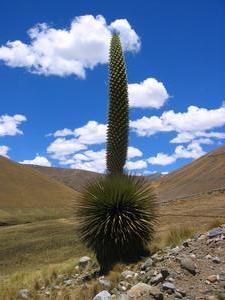
Puya raimondii pictured.
For more information on the Pitcairnioideae Bromeliad subfamily, check out my Bromeliad Subfamily – Pitcairnioideae post!
If you enjoyed this, please share it!


One response on “Puya Bromeliad Plants”
Leave a Reply
Resource Download
Hechtia Care Cheat Sheet
Learn how to care for your Hechtia bromeliad with this quick and easy informational guide.
Learn More
Ask an Expert
Questions about bromeliads?
Our experts love a challenge!
Monique
Bromeliad Aechmea
Photo of the Week
Submit your photo to be featured on the blog!
More Photo of the Week Winners
Submit Photo
Very inseresting , but I read that there is a subspecies of puya raimondii that is small and can be potted. Do u know what it is.