



Beginner’s Guide to Bromeliad Pups
Author: Melanie Dearringer157 Comments
As sad as it may seem, most bromeliads are one time bloomers. Your beautiful inflorescence will someday cease to be ornamental. Its bright color will dull and eventually brown. But before you toss your bromeliad in the trash, refusing to grow more attached to a plant that is destined to die off regardless of the amount of care you provide it, there are some things you should know.
When a bromeliad plant reaches maturity it will stop producing leaves and the flower will bloom into a beautiful, unique formation. At this point, the healthy bromeliad will produce offshoot plants from the base called pups. Pups are exact clones of the mother plant and are her way of continuing her legacy. So while the mother plant is preparing for the inevitable, it is leaving you with even more plants to care for in the future. Proper harvesting of the pups can lead to numerous beautiful bromeliads and the potential for an ongoing generation of bromeliads for your enjoyment.
For more information on pups, check out our FREE Beginner’s Guide to Bromeliad Propagation.
WHAT IS A BROMELIAD PUP?
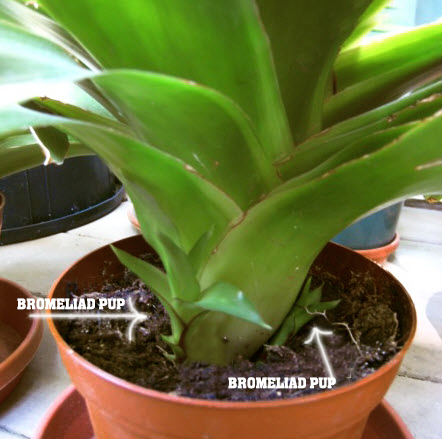
-Bromeliad Pups
A pup is the offset of another bromeliad plant. Pups can form at anytime but this most often occurs after your bromeliad has bloomed. Once a mature bromeliad reaches the point where it has a healthy bloom and a strong core, the original plant (known as the mother) will stop producing leaves and will begin producing its next generation of plants. Pups will not reveal a bloom at this point but you will be able to identify the cup forming as it grows upward from the base of the mother. It is possible to for the mother plant to have multiple offsets growing at the same time. When these pups reach a certain size they can be harvested, planted, and cared for on their own. The mother will continue to thrive and produce additional offsets for the next year or two.
Pups form on nearly all types of bromeliads. Propagation occurs in a similar way for each of these different varieties.
WHEN AND HOW TO REMOVE BROMELIAD PUPS
The longer the pups are left attached to the mother plant, the faster they will reach their own maturity. By leaving these offsets attached, they are able to take in nourishment from their mother, expediting their growth. However, removing the pups when they are smaller will allow the original bromeliad to focus the entirety if its energy on throwing even more pups. The choice on when to harvest is yours depending on your intentions.
Bromeliad pups can be safely removed when they are 1/3 to 1/2 the size of the mother plant. Another good indicator that the offsets can survive on their own is the presence of roots. Root formation is not necessary for a pup to survive so don’t be alarmed if they don’t exist yet.
Use a sharp, sterilized knife or scissors to remove your new plant, cutting as close to the mother plant as possible without injuring it. Sometimes there will be an outer leaf shielding the base of the pup. You can gently peel this leaf away to reveal the entire base.
Once the pups have been removed, simply replace the soil around the mother plant and it should continue to provide you with additional offsets.
HOW TO POT BROMELIAD OFFSETS
After the pup has been harvested from the mother, dip the cut ends in a fungicide and rooting hormone before potting it individually. Prepare a small 4″ plant pot with a light, well-draining medium. Because a pup’s root system is limited or non-existent, you may find the plant to be a little top heavy with nothing to anchor it down. When placing your new plant in within the pot take care not to set it too deeply in the potting mix in an effort to support its weight. Instead, use wood sticks or stakes to hold the plant up until it produces a root system that is able to withstand its own weight.
CARING FOR PUPS
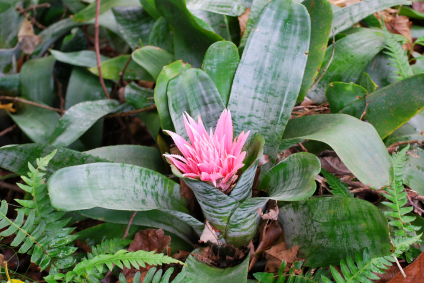
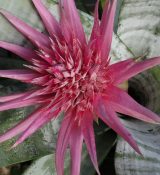
-Aechmea w. pink bracts
Light, warmth, and humidity are three important factors in growing healthy bromeliads. This is evident by their nature to grow in the hot climates around the equator and in other high moisture and hot temperatures regions. While newly potted pups enjoy bright indirect light, they require less light than full grown, mature bromeliads. Be sure to keep the new plants watered. It is best to keep the potting medium moist but not wet. Over-watering bromeliad pups can cause rotting at the base of the plant, which could lead to a low chance of survival at this critical stage.
As the plant becomes stable with its roots system you can remove the supports and allow it to start receiving more light. Provide the plant with some good light in the morning especially during the summer months. Shade for the rest of the day after the morning sun usually leads to a good bloom on a bromeliad.
Taking a bromeliad from the pup stage to full maturity is incredibly rewarding. It’s a process that can be repeated over and over and takes approximately 2-3 years. With the proper knowledge and care, bromeliad propagation can be a great way to build your collection.
Sources
Bromeliad Society International http://www.bsi.org/
Wikipedia http://en.wikipedia.org/wiki/Bromeliaceae
If you enjoyed this, please share it!


157 Responses to “Beginner’s Guide to Bromeliad Pups”
Leave a Reply
Resource Download
Hechtia Care Cheat Sheet
Learn how to care for your Hechtia bromeliad with this quick and easy informational guide.
Learn More
Ask an Expert
Questions about bromeliads?
Our experts love a challenge!
Monique
Bromeliad Aechmea
Photo of the Week
Submit your photo to be featured on the blog!
More Photo of the Week Winners
Submit Photo
I have a small-ish bromeliad which has never bloomed despite the fact that it looks quite healthy. It has grown a pup which (according to the information I have gleaned from this web site) appears ready for harvest. Should I go ahead and harvest, and hold out hope for the “mother” plant to bloom, or does the fact that she is already throwing off pups mean there will be no flowering?
Thank you
It sounds like you should be safe harvesting the pup. It might take time for the mother to bloom or maybe it never will even if healthy. If the pup appears healthy it should be safe to transplant on its own. Maybe that one will have a beautiful bloom in time.
From what I understand, a “mother” plant doesn’t grow pups until after it has bloomed and only blooms once in it’s lifetime. I don’t remember what website I saw that on but it was under bromeliad care. Once they bloom they only give off pups from then on.
I believe this is correct in almost all cases.
Mine bloom every year. I have had two very large ones with the pink flowers for 15 years . I set them out every summer sometimes they have 3 blooms each. This will be my first year harvesting pups.
What kind of bromeliad do you have, and where did you purchase yours. From a nursery or a store?
Same here . Mine blooms every year
So does the mother plant just keep producing pups?
I have a bromeliad that produced one pup. Months later it started growing a bloom. It’s still growing a flower and it’s been about a month.
Bromeliads do not necessarily need to bloom before producing offsets. Often it is normal for them to produce offsets before normally flowering.
A common example of this that everyone knows is Spanish Moss, Tilandsia usneoides
The website is wikihow.comhow-to-care-for-a-bromeliad
It says that a pup needs plenty of food, what type of food would the pup need? And the soil for a pup, where can you find the soil to plant it? Would Wal-Mart in a real rural area carry such that i would need?
Thanks a bunch..
Liquid plant food or fertilizer works well.
I have a Bromeliad houseplant that appears to have several pups as you call them. It had one huge bloom when I bought it, but nothing since. I don’t know how to “harvest” these pups. Please give instructions. Thanks.
Mine just fell off on their on, so I guess that meant they were ready.
Place a ripe apple in the pot and tightly wrap a plastic bag around the base of it. Leave it for 7 – 10 days. This will create a gas and force the plant to bloom again!
HaHa! Not likely. where did you hear this?
I saw this on another website too. Whether it’s true or not is a different question, but might be true. Who knows unless you’ve tried it. I don’t think it would make a bromeliad bloom again, but make one that hasn’t bloomed bloom quicker.
My landscaping guy told me the same thing. He sad to cut up these apples and put them at the base of all my bromeliads.
I am transplanting the pups. So the apples go at the bottom of the new pot under the soil?
Google ‘ethylene gas ripening’
It’s true, the decomposition of the fruit makes a gas that promotes flowering, it does not have anything to do with producing pups, and only works on bromelaids that have not flowered as of yet
Bromeliads will only bloom once. The “ripe apple in a plastic bag” method only works on bromeliads that have never bloomed. An aside: most plants that are “forced” to bloom typically do not bloom again. I noticed this to be true with plants that grow from bulbs, like paperwhites and yellow lilies. They died when they were done flowering, and the bulbs did not grow again after I planted them outside.
I meant to say “Most bromeliads” not “all.” There is virtually no such thing as something that says “all” and is true.
Yes, paperwhites Definitely rebloom..i know this because I was given some bulbs that my mother no longer wanted from her garden..they bloomed there and I put them in my fridge to “force” them to rebloom..fir approximately 4 weeks..then put 5hem in a glass vase with water..and bloom it was! Most sites say that they only bloom once ever 3 years..maybe i am just blessed..of course give your plants love..it goes a long way..and you will get blooms again..mine grow every year
My yellow lilies re-bloom every year! I have them in pots. The secret is after flowering, you dead head but leave the stem and leaves to die down themselves because this is how the bulbs get nutrition for the next year. Then repot into fresh compost every 2-3 years.
My mother bromeliad has bloomed and has a pup ready for harvest may I deadhead the mother plant since the bloom has dried and died b4 the pup appeared? Will it more than likely produce more pups? 😀
This happened to my Bromeliad and I , too, am wondering the very same thing.
The main bloom was healthy and looked good for about a year and, but for the past few months it has been turning more and more brown, withering from the top and working its way down. There is a pup though, that looks great. If I leave the pup there could it eventually take on the whole pot. Will the mother die off all the way?
You want to remove the pup when it is approximately 1/3 of the mother plant’s height. Place the pup in another pot with potting soil. Yes, walmart, kmart, agway, etc all sell soil. As far as i know there is no need for special soil. You may have to stake your pups to help them stand until they can grow roots which will support the weight of the plant. Oh, and as a side note, never use metal watering cans to water any bromeliads. The metal is actually TOXIC to your plants. That being said, do not use metal (like a coathanger) to stake your plants.
there is special soil, you want a sphagnum moss/organic soil mix, you can use also some other form of moss or ground up redwood tree bark seeing as how they like to grow on trees. Make sure the soil is organic because many of those soils are super high in nitrogen and will burn the plant… if your going to give it plant food I hear orchid plant food is the best.
Please be sure on the potting soil not to use regular Soil or just bark because not all bromelLiads thrive that way. I tried regular soil and bark and That did not go well. I have found the Orchid potting mix is similar to what you need. Something light that Can hold a little moisture but not pack down like dirt.
I left my mother alone other than watering. It as produced 5 pulse so far.
Wonderful, Debbie! Sounds like you have a great new collection of bromeliads.
When do, and how do you remove the spent flower? thx
When the flower turns brown, take a clean sharp knife or scissor and cut down as close to the plant and throw the flower away…
The tips of the leaves of my mother bromeliad are turning brown and there is a pup at the base of the mother. What causes the browning of the leaves and what can be done about it?
I see no one answered your question, just said “remove the mother”. Maybe your brom is getting too much sun or too much fertilizer. You really only need to fill the cups of your broms with water till it overflows and give a little water to the soil/bark/growing medium every now and then. The browning could be any one of many things including lack of humidity too. Sorry for the vague response.
Your mother plant is dying. You should remove the pup when it is about a third as big as the mother an plant in its own pot. If there is no roots support the pup with stakes(not metal) till it can support itself then you can remove them. The mother even though dying may even give more pups till it has died.
My mother plant was purchased while blooming and has since generated two small pups. After the bloom died, the mother plant started to wither and turn brown. All of here leaves are mostly dead at this point. The mother plant was about 1.5 feet in circumference. The pups are very small, about 1.5 inches in circumference. Should I leave the pups with the rapidly dying mother plant or remove and re-pot them now?
Why not cut the mum off at her base and leave the pups as is, they will still have the original root system then and keep on growing. Caring for broms is not rocket science, just use common sense.
Is this correct?
I love this idea! Thanks. 🙂
I kept my plant in my classoom. I watered every Friday afternoon, and it was looking great! Unfortunetly, a freak snowstorm cancelled school for an entire week. When I got back (9 days later) the mother was brown and dried up. I continued to water and take care of it, but now I am not sure I can save the plant. Can I remove the dead head? i haven’t gotten any pups yet….thank you!
In short… no
Sorry, but it is probably dead. Hard to revive. I pour a little water in centers daily., but cold is a killer.
Does the mother Bromeliad always die after it has produced at least one pup? One of my 3 Bromeliads has a small but healthy pup but the flower on the mother plant keeps turning more and more green. the tips of my bromeliad’s leaves are turning brown. Is my mother plant dying? and if so, should I dispose of it right after I remove the first pup or once it is completely dead? Thanks!
Several people here have asked about removing the dead flower from the mother, but I have not seen any reply as to how to do that. Do you just reach in & cut it out or try to pull it out? I have 3 pups growing from mother & I am excited for when they get large enough to disconnect them & start them on their own. This plant was from my granddaughter & her little girl who are no longer with us – so it is very special to me. Any help is appreciated, thanks.
Yes. You can cut it out close to its base with a sharp pruning sheer. This will ensure the rest of the bromeliad remains healthy.
I tried to just pull my brown Center out, after it bloomed, had pups, it turned brown, but it won’t break loose. How far down do u cut it? This is my first 1,had about a year, got 2 pups in containers from mother already. Please help
I just bought a Bromeliad recently and after reading this article, it sounds like my plant has 2 pups that are ready to be harvested or are close to ready. Will all three plants continue to grow well if I leave them together and upgrade them to a larger pot, or is it necessary to remove the pups?
Remove them, don’t remove them, it is up to you. I find a mass planting (ie: leaving them together) to be even more of a great display. This is how they grow in nature, nobody goes around removing the dying mother or pups out there in the wild.
My Bromeliad was a very healthy flaming sword Bromeliad, but now her flower has died and her leaves have started to turn brown. I am worried because she still does net have any pups. Is there any way to encourage a Bromeliad to have pups?
Find her a handsome pot-mate!
I fear her conditions were less than desired. I fear there is no hope.
Can you plant the separate pups together in one big pot?
Yes that’s fine.
Thanks. How far apart do they need to be?
I read somewhere that pups should be put into their own pots (seperate ) to give them room to grow
My bromeliad was completely brown and looked dead. Just as I was getting ready to throw it out I saw 4 pups! That was 4 generations ago. Be patient and keep giving your dead looking moma a little water now and then. You may get pups.
My bromeliad is turning brown its dying it has a pup do I take the dying flower out?
What temp should i keep my air conditioner on?
They are tropical plants that live near the equator…. Why are they in an air-conditioned room? lol. Warmth, water and high humidity is what they need. Perhaps a large terrarium would suit them if they are inside in air-con.
Do I HAVE to remove the pups? My mother plant has FIVE pups right now, and all – even the mother – appear to be doing well. I tried to remove one pup about a year ago, pup didn’t last. What happens if I just leave the pups on the mother plant and do not remove them, perhaps just put them all in a larger pot to allow room to grow?
I’d rather now remove all of the pups. Is this o.k.?
Keep them together, they will look AMAZING when in bloom. Just cut mum off at the base when she is spent as if you don’t she may rot and cause damage to the rest of the broms in the same pot.
Could someone please post a picture of a “pup”. I have a Bromeliad & I think I have 2 pups but not sure. Just need a picture to make sure before I pull these apart from the mother plant. Thanks!!!!!
If its not a regular leaf or an inflorescence it’s a pup.
Here is mine
The pup will literally look like a “baby bromeliad” growing right up next to the base of the mother plant. I found that after I cut back a leaf that was curled up and browning, up pup was actually growing out from where the leaf attached. Hope this helps!
Once the bloom is no longer alive and has been removed, do we cut the hard stem left in the middle and remove it also?
JUST LOOKING for answers to all the above questions
I need this answered too cat. I live in central Florida by the way, they are indoors. My 2 pups and 1 mother plant. The mother plant is huge around
Hi so about 11months ago I began to see the beginning of a bromiliad pup I was very excited! A month later a second one popped up after 3 months they were about 6 inches and people online said that it had to be 1-3 of the mothers hight and I couldn’t wait so I cut them from the mother and moved them to another plant. About 5months ago I saw another popping up. I want as excited to move this pup as the others so I kept it in till it was about 10 inches or so. And that was 2 month ago. In those 8 and 2 months my bromiliad pups have not grown to much the the first two have barely made any difference and the 3rd has opened it’s leaves the tiniest bit. Is there any way to get them to grow? Am I doing something wrong? 1 water te probably every week 1 and they get sun every morning for about 4 hours am I takeing care of them wrong? Just yesterday I was sad because I thought my mother bromiliad would never have another pup but just today I found one picking out from under her. Should I do something different? And is there any way to save my other bromiliad pups? Thanxs so much
-ivy
I believe the problem everyone is having is watering. you never are supposed to water the soil. Ever. Only water inside the cup of the plant. That is the only way to water bromeliads. I currently have one that is 10 yrs. old. And is 3 mother plants. Obviously I should have replanted sometime back but the 3 together were so lush looking together; they looked like a beautiful live sculpture. Now I must repot, but again…any light weight soil. I have witches hair (whatever it’s called. Not sphagnum) that covers the soil lightly. And they like indirect sunlight. Under a skylight; or window that is treed.
btw: I have always liked to have my bromeliads close to indoor bird of paradise. I had two that were
16yrs.old & 10yrs.old when I moved recently.
Bird of Paradise & Bromeliads can take abuse & are not delicate in any way whatsoever. Also, I always water w/a cheap time watering can. Good luck ;]
meant to add that the flowers will bloom for abt 14 mos. b4 having to cut them off. Amazing plants they are~
It’s simple. Think about the broms and how they grow in nature and replicate it to the best of your ability. Can you water the soil occasionally? Of course you can! The soil would certainly get wet once in a while in their natural habitat in the jungle etc. Water the cup as stated above, if you are in the heat don’t let the cup dry out. If you are in cold climate, avoid cold snaps and frost, provide warmth, maybe a humidity tray and water accordingly, if you are in the heat keep out of direct sun and water lots.
The above comments are spot on. I’ve found – from working at a florist and owning several bromeliads – that bromeliads tend to die from too much care, rather than the opposite. Avoid temperature extremes, don’t overwater, don’t let anything made of copper touch them or the soil they live in (copper is toxic to bromeliads) and your bromeliad should live several years, and will give you several exact replicas of itself along the way. I consider myself to have a fluorescent orange “thumb” (the opposite of a “green thumb”) and I’ve never managed to kill a bromeliad yet.
Thank u Gina
My only one, with pups, until I transplant is in plastic, in a pretty ceramic pot. I daily water center. A couple times a wk, I pull out of fancy pot, wash leaves, drain pot, soak soil & center, Sitting in water causes rot. Water center of mother & pups, but no standing water at bottom
I purchased a Bromeliad Special it has thin long leaves and in the middle of them is a towering very bright pink, almost flat, oval, spiked ‘fruit or cactus?’ that had on each side one small dark purple bloom on the tips of the spikes and they would die a day or two later and within a week or more another one to two blooms would pop out again. In the flowing leaves there are two new pups growing. Shortly after I brought this plant home the very bright pink fruit has faded to light green except for a light light pink at the peak. When I went to the nursery I saw more of the same kind of plant and they were still brightly colored. Will the pink ever come back? The center piece is growing taller with more leaves sprouting and purple blooms appear, just not as frequent. Do I just leave the center fruit there? When I do transplant do I remove the pups and plant them? After I transplant will the bright pink return to the fruit and will it continue to have pups?
Sounds like a Tillandsia, I have one in a 15cm pot. Whe I received it as a gift there seemed to be one main plant in bloom and a half dozen tiny pups, The bloom eventually died, I kept watering the whole thing, the pups grew larger, about 20 months later 3 more blooms have come up simultaneously. Once those new blooms are spent I’ll probably transplant the whole thing to a slightly larger pot and freshen the soil.
give it more light and the colour should come back
Hello all,
I’ve had my brom for about 5 months, the mother started growing a few pups about a month ago. Well needless to say a few days ago my nephew decided he wanted to go outside and cut some wild flowers for his mom. He brought back the bloom of my brom. So I immediately called my florist where I got the plant from( she has a few thriving broms herself). She told me that the bloom and about 2/3 of her plant had got cut off as well, she said that i should just keep what’s left of the mothers cup full of fresh water and to just give the plant about an hour more of light a day. She had told me of a website she had read about it on…and that as long as the pups were evenly spaced that they would form a cluster and would be just fine.
So, I harvested my pups last fall, replanted and they have grown quite nicely this summer, but do not seem interested in blooming. How long does it take for the 2nd genration to bloom? should I store these for another winter, or just toss them out? fortunately, the foliage is rather attractive, so I don’t really mind them. I just hate giving up plant real estate to non performers….
I have 3 pups around the mother-can I plant all 3 pups together? I plan on throwing the exhausted mother. Thanks
Do it, do it. The more clustered together the better the display when in flower.
You’re looking at 2-3 years to bloom…
Congratulations on your new little bromeliad pups!
I have A 12 YEAR OLD BROMELIAD That HAS FLOWERED TWICE. ONCE AFTER PURCHASE AND THE OTHER ABOUT 5 YEARS LATER.. I HAVE NEVER SEEN PUPS AND MY PLANT IS STILL GOING STRONG. IT has NOT FLOWERED IN years. BUT MY question IS WHY IS MINE STILL ALIVE AND WELL? I CAME HERE looking TO SEE HOW LONG IT WILL LIVE AND AS I READ ALONG , IT SEEMS AS IF MY PLANT IS unique. IT SITS roughly 3 FEET WIDE FROM TIP TO TIP OF THE LEAVES AND ALMOST A FOOT AND A HALF FROM SOIL/ROOT TO LEAF TIPS.
There are a few bromeliads that bloom more than once in their lifetime. Feel free to submit a picture of your bromeliad and we can help identify it for you.
IT IS A FLAMING SWORD bromeliad. HOW DO I SUBMIT A PICTURE? COPY and PASTE OR A LINK OR??
I have a bromeliad that is throwing up pups, but they are close to the centre of the plant. How do I remove these without damaging the mother?? It seems I would have to remove all outer leaves to get to them.
Do I need to water the pups in their little cups like I do the mother?
No, they will survive with no water ever…. they are special magical plants you see. lol, yes, fill the pup cups with water.
I am wondering what ever came with your pups that were growing in the center of your bromeliad? I have two in the middle of mine and am also curious as to if I can transplant those pups or if I must leave them?
Must I use a rooting compound to successfully grow my new Pup?
No.
My plant is getting brown from the top middle, the outside seems to be alright, do I cut the brown leaves off, or o I just have to leave them alone?
Was there a bloom that is now dying back, or is your bromeliad plant simply becoming brown from the center out for no particular reason?
I bought my bromeliads while they where in a Beautiful bloom About a little over two months now. Now the leaves are beginning to wither. I have checked and there are no pups. What can I do? Is there anything I can do to get some pups before they die for good? I was really looking forward toharvesting pups.
How low shd a dead flower’s stem be cut?
As low as possible without harming the foliage.
My bromelaid (bright orange flowers in a ball) is 10 years old and has flowered for the last 6 years. and now it is flowering for the second time since march! I did not know about pups so I have left 2 with the mother. They are just as big as she is so i cannot see how to separate the root system which is very large. i just repotted today so there is depth for the roots. i use soiless soils and 20.20.20 fertilizer once a week from may to september each year. i let the plants dry out which is once a week. the pups have not bloomed as yet and one of them is 6 years old. but mom is still going strong! maybe i can upload a picture.
Can I plant my pup in regular potting soil mixed with spag. Moss without using rooting compund and fungicide?
Yes you can. The rooting compound and fungicide is just an extra precautionary measure to keep it healthy and give it an initial boost.
I have been told that some bromeliads purchased from nurseries are sterile and will never throw pups. Is this correct?
i believe they will produce pups unless they arent healthy… ive bought my bromeliads at several places including home depo, ingles (local grocery chain) and harveys (another grocery store) and only one hasnt produced pups yet.
No. Just an old wives tale.
i had one question and i cant seem to find an answer to it anywhere on the internet… i bought my bromeliad when in bloom of course, it was doing great no problems… the spikey pink flower started its little purple petals and then my daughter ripped the flower out of the center. since then the plant looks completely healthy but has not produced pups. without the flower how will i know when and if it will produce its babies?
its an aechmea if that helps… im just confused and hoping it will give me little ones soon.
Watch the leaves for browning
You won’t. Just keep watering it and sooner or later either you will get pups or mum will wither and die.
I received a bromelaid A few months ago. It had already bloomED. I decided to grow it in a larger pot and it seemed to be doing fine. The plant started to rot at the base i ober watered it. I changed The soil in the pot but it was too late. The mother had produced two pups. I was aBle to save the one puP but it has no leaves. Also the mother plant has no leaves die to the fact that it was rotting. Is there any way i can saVe Both the mother and pup? Can i pit the plants in water and wait for roots and regrow them in soil??
(I apoligize for the caps; i don’t know how to make lower-case letters here.) No!!: these plants are very different from some gardening plants. If you water their soil too much, they’ll rot – never mind putting them -completely- in water! What you -should- do is pretty much the reverse:
-put in soil. But not very deep. Instead, just use (non-metal) stakes to hold the plants upright, until they can hold themselves.
-don’t overwater (you should water once a week, or maybe -barely- more often for these specific ones). when watering, it just needs to be enough to get the soil moist, all the way through. Then, for -healthy- plants, you should wait until the ({top, or all?} of the) soil just -begins- to dry out before watering again.
-Again, even though these plants -aren’t- completely healthy, do not water them much more than you would for healthy plants! I say this, because that might actually be the -cause- of your plants rotting.
-Well…I don’t know anything else that you should do besides those few (OK, but long) planting instructions. Just what I’ve read around the Web. However…all (or probably most) of what I’ve read has been pretty much the same, so that means I’m finding the sites with -accurate- information.
Oh, and it looks like using rooting hormone would help.
And that a fungicide might -possibly- help. But only if that is, actually, the problem you’re having.
No, the plants are struggling as it is, why over complicate it with added bs.
I don’t get it? If the pup has no leaves and the mother has no leaves then what do they have? A brom is basically all leaves and not much else.
I have had about 8 pot from two different plants I water them about once a week but did not water in the base is that the problem and can I give it some food or fertilizer?
8 PUPS, NOT POTS. THEIR LEAVES GET WILTED. I DONT THINK THEY ARE TOO DRY. MAYBE TOO WET. SAD THAT IVE LOST SO MANY AND THE MOMS HAVE PRODUCED MANY. ONE MOM HAS GIVEN ME 8 PUPS OVER A SPAN OF A YEAR AND MY OTHER HAS GIVEN ME 3 WITH ONE MORE ON THE WAY.
I removed my pups from the mother plant as per the standard instructions, when they were about 1/3 size of the mother plant. they’ve been in their new pots for just under a year now. they have not grown at all but are not brown or dying. they just are not growing. is this normal? Is there anything i should be doing to help them grow? or will it come in a spurt when they are more mature?
They will come good, keep watering and fertilise once new growth is seen or it starts to warm up. Are you in Russia?
Keep watering the cup and fertilise once new growth or warm weather starts, it will come good. Are you in Russia?
Qi transplanted two pups. I used peAt mOss type soil. When i water the pups (each in its own pot) the water drains through and within a few hours the soil is dry. I dont want to over water but how do I keep it moist? Also, i fes the pups when they were first transplanted ( three weeks ago). When should I feed AGain?
Whack a little sphagnum and bark in the mix, water it in the cup of the brom and Bob’s your auntie they will be the ducks nuts in no time. Oh yeah, maybe don’t feed for a while till you see new growth. Remember, water the bromeliad cup rather than the soil/potting medium.
Gosh ! what a lot of interesting information I have gleaned from this website !My mother,s day gift was a Bromeliad,the first I have ever owned ( At 88 years old )and I am looking forward to caring for it and looking for pups.I have three real pups,I never knew that plants could have pups !.
my bromeliad is in full bloom, the center of bloom is a buttercup yellow, the rest of bloom is rich red. there is no sign of any pups. Does this mean none will pop up?
Pups will come after the blooming stage.
Hi. Bought 2 bromeliads in separate pots on sale last Sept. Both thriving now with pups. My bromeliads never had a bloom. Their center and cups areas are fuchsia in color, as if spray-painted. How does that occur, and will pups eventually take on the same striking hue?
Yes, eventually your mother plant will fade and die but your pups will be the next generation! You can separate them into their own pots if you’d like when they are about 1/3 or more the size of the mother plant and have roots.
I knew absolutely nothing about non-canine pups when I bought one along with tiny terrarium plants. After reading the Q&A’s here it looks like sticking my pup in a terrarium was a mistake. Am I right?
I bought a flowering bromeliad from Walmart two days ago. The soil is heavily soaked and the cups were also watered at the store. Is it safe to repot it now with an orchid mix so it doesn’t rot?
Yes if you feel it is over-watered and might rot, you can go ahead and re-pot. If you’re in a climate where it will dry out quickly, just wait for watering it again until you see it’s sufficiently dried out and will not be left soggy again.
I recently purchased 5 different colored, beautiful bromeliad plants. 4 of them are in alone in small pots and the 5th one has 3 huge plants growing together in a large pot, however they are all different colors. I’m very new to growing plants and although I try my hardest to do everything I read online necessary for the plants to thrive, unless they typically can just be thrown in the dirt and survive if never cared for again, then most of my beautiful flowers end up dead. So, I am very nervous about killing these bromeliad’s also! Can someone please tell me if there is a site that shows exactly what the name of each bromeliad is and the growing guide for dummies with not so green thumbs? lol
Kelly — check out the Resources section of our website. Here you can find free care guides and an identification chart.
I’m with u Kelly, I’m new with these
Good information, my bromeliad is also turning brown haven’t seen a clone yet.
Is it typical to have 5 pups growing off one small mother brom? My norms sit on the porch in the shade out of direct sun. Is that OK? I
In some Bromeliads pups form up to 10 years before it blooms and when the plant is 1/10th full size and the pups can be continuously removed from the plant over the 10 years . Perhaps the most notable examples are Alcantarea species
I cut off two pups without a root system and they are pretty big. One of them retains the water in the tank, while the other one doesn’t. Do you think it’s ok to put a small piece of plastic under the one that loses the water from the tank? Once I did that, the water is now retained.
I read you are supposed to dump the water out of the cup once a week. I have and it is quite messy because the small root system, if that is what you call it. I really see no roots. Anyway…is it necessary to empty this cup?
Is there a specific season of the year when to remove the pup? Spring? Summer? Etc.
Follow your bromeliad’s growing rhythm. Once it is finished blooming it will then produce the pup(s). When they are 1/3 or 1/2 the size of the mother plant they are ready for removal.
I was given a flowering Bromeliad (bright red flower) in August 2016. In October it started producing purple pups and now has 6. I like the idea of a large display and would like to re-pot from the existing 8cm diameter to a larger one. What size pot will be suitable and should I remove existing soil or can I just add to it. Will orchid soil be suitable, and when should I re-pot the plant. It seems to like the kitchen windowsill which faces west and only has direct sun for a short time each day in summer. Will this be too dull in winter? This pot plant is giving much pleasure and I hope to have it and its pups for some time yet! Thank you.
one of the reasons I got a bromeliad was because the little card said it didn’t need to be fertilized….why is this site saying otherwise….is it just for the pup stage? I’ve had my bromeliad for over a year, never fertilized it and I barely water it. I was told it’s supposed to remain rather dry and to just put water in the “stem” part. So I’m not sure how to water the pups. One seems to be doing okay but I want to make sure it blooms.
Great info. Thank you Bromlover for keeping it simple. the less I fiddle with them, the healthier they are.
I have three pups from a plant my daughter gave me for Mothers day last May. I harvested 3 pups after mother withered. 1 pup rooted but 6 months later still no roots on other 2 pups. how long do they take to root. They look healthy and getting new growth from the middle, but no roots. Can you help
my daughter gave me a pup off her mother plant. She put it in soil and a pretty pot for me. Ive been letting it sit on my table in the living room were it gets plenty of light. But the little leaves are starting to turn brown on the ends. I water her only slightly and put water inside the pup. I use a ketchup squesse bottle so I wont put in to much water.So why is she starting to turn brown. I even sit her next to my orqide which is by a humidifyer. Sorry about the spelling its not my strong point.
Hi Donna, is it the green leaves that are turning brown or the flower (that sometimes looks like a continuation of the leaves) on the plant?
I had my front yard landcaped and the garden center I went to planted a lot of bromeliads, a few had already die from root rot and I had them replaced again as the owner said they gave two month replacement warranty on plants. I live in the Philippines a tropical country and right now it’s been raining a lot and I’m afraid all those bromeliads will rot from too much rain water..The owner managing the garden center said that bromeliads like water so they won’t rot from over watering. I did some research myself and bromeliads are said to be very prone to root rot when watered too much. She may have no knowledge at all about bromeliads. It’s been raining a lot and I noticed another bromeliad smelling like a sewer and leaves are turning brown in the center with stagnant rain water. I tried draining it and seems to be rotting already. I don’t know if I can stillsave ot but will put it in a pot and place it my veranda to avoid rain.
I’m sorry, that sounds very frustrating! If the inner leaves are intact and do not come apart when tugged, you may be able to save your plant.
Dip it in a fungicide or a root hormone that also contains fungicide. Then, stake it up in a well draining potting medium or next to a healthy bromeliad. The bromeliad should recover and develop roots.
I potted two pops three days ago. Here in Milan it is too hot now and even with air conditioner my home is 33 degrees. The new pops look yellowish now. What should I do? Should I move them to the corridor? Should I wait? Should I don’t mist the leaves? I am so sad for them. It is like my own children are sick
Is a bromelaid consider a bulb or shoot or tube or what??
Bromeliads are monocots and comprise of the plant family Bromeliaceae.
Hi, lots of interesting advice here. I brought my first bromeliad at a market just over a year ago, with six blooms, since then I’ve been hooked lol.
And have brought many more since, they all seen to be doing well. I have read how they prefer rainwater, and have been watering with it, but, I have also read on a couple of internet sites where bromeliads do not like metal. Will the benefits of rainwater be overshadowed by the possible negative effects of a galvanised rain water tank and should I just use tap water. All the water to our house runs through metal pipes, so, either way, metal cannot be totally avoided.
I bought a bromeliad at a gardening store last year and it bloomed beautifully. I didn’t realize it when I bought it, but the plant had many pups already growing on it. When the flower started to fade, I removed the pups – 7 in all. I put them in normal potting soil this past fall, and brought them inside. They’ve been living in the tub in my master bathroom. I have watered/sprayed them throughout the winter, and they look fine, but I have noticed that they haven’t taken hold of the soil If I bump them even lightly, they’ll fall over completely. Is this normal? Or is it because they don’t like the normal potting soil? (I realize now I need something more like for orchids). Do I need to dip them in rooting hormone?
I have a bromeliad that has a large bloom that has since died. The stem is very thick. I’m not sure how to remove it. Any advice?