



Bromeliad Care and Culture Overview
Author: admin124 Comments
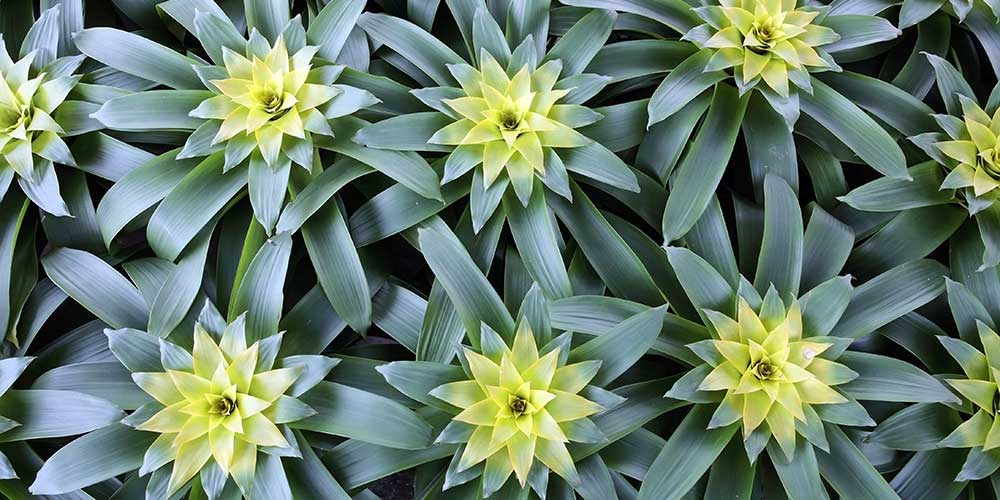
Bromeliad Care and Culture Information Overview
Information about the care and culture of bromeliad plants including ideal light, temperature, humidity, air circulation, water, soil, planting beds, potting media and fertilization.
Light
Bromeliads tolerate a wide range of light intensities, including low light, for long periods without ill effects. The plants, however, will look better when they receive proper light. Although optimum light levels vary considerably, the following characteristics are helpful in selecting a spot for a particular plant. Generally bromeliad species with hard, thick, gray, gray-green or fuzzy foliage withstand the highest light levels, while species with soft, green, thin leaves grow best under lower light levels.
A general recommendation is to grow bromeliads where the light level is approximately 1,500 foot candles or where orchids grow well. In a home, a window with a southern, eastern or western exposure is satisfactory for bromeliad growth, but most species must not be exposed to the direct rays of the sun.
In most instances, a bromeliad will indicate by its growth habit whether light levels are satisfactory. A yellowish or pale green plant may indicate that the light level is too high. Conversely, a darker green than normal, with a more open or elongated shape, may indicate low light levels.
It is difficult to categorize bromeliad genera into optimum light levels, because light requirements of species within a genus may differ. The following generalizations can be used as a guideline, however, when selecting bromeliads for a particular site. Plants in the genera Dyckia, Puyas, Hechtias, Ananas and the hard-leaved species in Aechmea and Billbergia grow best at high light levels. Plants in the genera Guzmania, Neoregelia, Nidularium, Cryptanthus and Vrieseas can grow under lower light levels.
Temperature
The majority of bromeliads are tropical or subtropical and thrive outdoors in Florida’s high summer temperatures. Many tolerate temperatures in excess of 100°F. In a home environment, however, bromeliads do best at 70-75°F during the day and between 60 and 65°F at night. Bromeliads native to central and north Florida tolerate temperatures slightly below freezing for short periods, but most introduced species should not be exposed to temperatures below 40°F. As a general rule, the softer-leafed species need a higher temperature, while those with very hard, stiff leaves are much more tolerant of cold.
Humidity
Most bromeliads grow best indoors at a relative humidity of 40 to 60 percent. Unfortunately the average humidity in most homes is well below 40 percent, especially during winter months when heating systems are operating. Humidity levels in the home can be increased by installing an inexpensive humidifier. Humidity in the vicinity of plants can be improved by placing potted plants on a 2 or 3-inch bed of wet gravel. Water evaporating from the gravel increases the humidity. The bottom of the plant pot should never be in or under water, because this causes waterlogged medium, possibly resulting in root damage. Another method of increasing the humidity around plants is to mist them with water frequently during the day.
Air Circulation
Bromeliads, due to their epiphytic nature, require good air circulation. Fresh air supplies them with carbon dioxide and moisture. Plants grown in stagnant air are more apt to be attacked by scale insects and fungal organisms causing the bromeliads to deteriorate rapidly. Air circulation can be improved in a home by simply opening a window on days that are not too cold or by turning on a fan at low speed for most of the day.
Water
Bromeliads are extremely tolerant of low-moisture conditions and will survive prolonged periods of drought. Most of the problems encountered with bromeliads are usually associated with rot caused by over watering. Growing these plants in light, porous potting mixes that drain rapidly should help prevent this problem. Bromeliads grown in a potting mix or in the landscape should be watered when the soil surface feels dry. Plants grown in pots should be watered thoroughly, until water runs out of the bottom of the pot and then not watered until the medium surface feels dry. Under normal household conditions watering thoroughly once a week is usually sufficient. In homes where the relative humidity is low (during winter months and in air-conditioning) plants must be checked and watered more often.
Many bromeliads are formed of a rosette of broad leaves which creates a “cup” or “vase” in their centers. If the plant is supplied with moisture by wetting the soil around its roots, it is not necessary to keep the cup filled with water. Most bromeliads adapt so well to culture in a pot that they absorb the needed moisture and nutrients through their root systems. Keeping the cup filled with water under low light conditions that exist in most homes encourages bacteria and fungus problems. If the cup is kept filled with water, it should be flushed out with plenty of water periodically to prevent possible stagnation. Periodic flushing also prevents a build up of salts left when water in the cup evaporates. Water should be removed from the cup if the temperature is likely to fall below 40°F. This practice will prevent cold damage which appears as a brown line across each leaf at the water level.
Epiphytic bromeliads, such as those found in the genus Tillandsia, are often grown secured to a board or bark. Because these plants have no distinct cup to collect water, they absorb moisture from the air through their scaly leaves. Unfortunately, in an indoor situation, where the humidity is usually very low, they are unable to obtain adequate moisture from the air. Moisture can be supplied to these plants by misting or dousing them in a container of water daily.
Soil and Planting Beds
Bromeliads have a limited root system compared to other flowering annuals and perennials. Roots function primarily as a support or anchoring system. Bromeliads absorb water and minerals through their leaves from the moisture in the air and through their cups. They are not as dependant, therefore, on their root system as are most other plants. It is important, however, to keep their root system alive and in good health. The epiphytic nature of bromeliads prevents plants from tolerating heavy clay soil. To improve these soils, incorporate 2 to 3 inches of organic matter (peat, leaf mold, compost, etc.) into the planting bed. The sandy soils of Florida are usually well drained and good for growing bromeliads.
Potting Media
Most bromeliads grow best in a very porous organic medium which permits quick water drainage and sufficient air circulation around the roots. There is no one potting mix which is better than any other, however, the following mixes are suggested:
- One part peat, one part bark, one part coarse sand
- One part peat, one part bark, one part perlite
- One part peat, one-half part leaf mold, one part coarse sand
Osmunda fiber, unshredded sphagnum moss or tree-fern fiber may substituted for peat moss in these mixes. Some bromeliads thrive best when grown in a medium composed only of osmunda fiber.
Fertilization
Actively growing bromeliads respond to light applications of fertilizer. During the winter months, or under conditions of low light, they require little or no fertilizer. A general purpose, liquid houseplant fertilizer can be applied to the potting mix at 1/3 to ½ of the recommended dosage every 1 to 2 months. It is best not to add fertilizer in the cup because this could lead to an accumulation of fertilizer salts that may burn newly emerging leaves.
Controlled-release fertilizers can be incorporated uniformly throughout the potting mix at planting and applied on the medium surface of established plants. Bromeliads usually grow much better with a continuous nutrient supply. Labor is also reduced because controlled-release fertilizer application frequency is less than for rapid-release fertilizers.
If you enjoyed this, please share it!


124 Responses to “Bromeliad Care and Culture Overview”
Leave a Reply
Resource Download
Hechtia Care Cheat Sheet
Learn how to care for your Hechtia bromeliad with this quick and easy informational guide.
Learn More
Ask an Expert
Questions about bromeliads?
Our experts love a challenge!
Monique
Bromeliad Aechmea
Photo of the Week
Submit your photo to be featured on the blog!
More Photo of the Week Winners
Submit Photo
I live in the Piedmont area of South Carolina, I sell a lot of Bromeliads, I am a floral manager for a grocery store chain. I appreciate any info you have on this plant.
Just started with bromiliads and wondering it they will grow in sphan. moss?
No!
spagham modd will keep them too wet
@Mirrian – Keep coming back, we should have plenty for you to read through to find out more about bromeliads in general and even specific types of bromeliad plants.
@Nancy – Welcome to the site, glad you found us. Do the leaves appear to be burnt looking? Typically, browning is attributed to the growing conditions, environment and possibly even insects or disease.
Over fertilizing can also cause the plant leaves to brown or even curl. Try moving the plant from it’s current location to another suitable spot. Inspect your plant for insects and make sure the plant is not getting too much water, light, fertilizer or humidity.
Florida is native to many scale insects and mealybugs.
I live in Zephyrhills Fl. I just got interested in Bromaliads. I think they are very pretty, but one of mine is getting brown on the leaf edges and through the leaf and I can’t figure out why. I also would appreciate all the information you can give.
bought two bromaliads at c.v.s . they were doing quite well { only keep water in center as directions said, larger one started giving a little more water then let drie , everyother day approx. } now tips and middle leaves turning brown?
I recently bought my first Bromaliad. It is kept in doors and the leave tips are turning brown and curling under. I have not added any fertilizer nor have I seen any insects. There is also tiny little circular brown spots on the leaves themselves. I read that excess salt left behind after watering could be a possible cause. Any suggestions?
@Lorie – Make sure that the roots are not in sitting water. Bromeliads require a very well drained watering. Over-watering and under-watering symptoms can be similar. Also the description of small brown round spots sounds very much like scale insects. They may not look like your traditional ‘insect’ so look very closely.
I live in mn and mine is doing well. But however it looks like I have 2 more starting at the base of my plant. Do I try to transplant or just put in a bigger pot? First time owning one of these
I received a thin leafed bromelaid in December and about a month ago the flower turned brown and dry. What can I do to salvage the plant and return it to health and hopefully gain a new colorful flower? Also, what did I do wrong? I live in Murfreesboro, TN and love the plant so much, I recently purchased a second one, only it is a broad leaf.
@Sandy – Bromeliads only bloom once in their lifetime. You probably didn’t do anything wrong. If you keep taking care of the plant it may produce pups that you can grow and get to bloom after one year of growth. You will find lots of useful info on bromeliads.info to point you in the right direction.
My bromeliad problem is that my leaves are turning yellow and limping the the middle not the bottom leaves. Is that too much water or not enough. Should I remove these leaves, and if so, how?
My husband and I purchased several bromeliads while on vacation and I think we waited too long to replant them and they all seem to be drying out and dieing. Can I cut off the flower part since it has lost its beautiful coloring? Will it come back?? HELP!
Bap
I inherited a Bromiliad with a yellow flower. It looked scrawny when I got it and I wanted to rescue the poor thing. The leaves are thriving but the bloom never recovered and is turning brown. How do I best I cut it off? The mother plant seems to have grown a couple of pups so I would like to keep the mother plant. How big do the pups need to be before removing them and how do I do it so that I don’t hurt the plant? Tanks for your help! D. Y.
@Dorothea – It’s hard to hurt a bromeliad by cutting the pups or a bloom as long as you’re taking good care of it. The pups should be allowed to grow for at least a week or so before you separate them. Good luck with the new bromeliads!
I was unhappily surprised to hear that bromeliads only bloom once in their lifetime. Is this really really true? I’ve been trying to keep a thin leafed green one alive for 4 years (without flowering) that a friend gave me. Maybe it already flowered.
Put your plant im a plastic bag with a ripe apple fir a fee days, the ethylene gas makes it flOwer again
I just bought a bromeliad and I want to know if it is ok to leave it in the origainal small container if not can I use the miricle grow planting soil?
@ Claire – Bromeliads are mostly Epiphytic Plants and when potted on soil it is more a holding medium rather than for food or nutrients. Excellent water drainage is always a strict requirement when using pots. Feeding is not really required, but if you are using soil, time release pellets will boost appearance and blooming. Otherwise it is best to use organics like fish emulsion. I don’t see an issue with using the Miracle Grow soil, but you could certainly find a better way. Let us know if you need some potting media ideas.
I am unsure how to sepearate the pup. I have a silver cup (Morgana). It has grown out of the base and I am unsure if I should cut into the plant and down through a section of the roots to remove it, or if I should just cut it off where it attaches and then somehow root it. Any help is appreciated.
I was told by a few knowledgeable people to let the “mother” almost die and deteriorate before removing any pups as they need the nutrients of the dying mother to help support their growth. Idk, just my .02. (But if i had to, id try and get atleast some of the roots if i didn’t or couldn’t wait)
My mother plant has had 5 pups and I cut close to the mother plant by about 3 weeks after I cut the pups off I was getting more pups and the mother plant is still a live
My mother plant has produced many pups and I cut them when they are half her size and repot. The mother plant never created a flower until last time, I did this it has taken 7 years of caring for it.
I believe that I over watered my Bromeliad and the flowers are beginning to turn brown. I’m not sure if this is due to overwatering or the small size of the pot it came in. The leaves are still healthy. Please let me know what to do so I can get the flowers looking healthy again.
Thank you!
I’m a newbie. Got my first bromeliad as a reject from the reception flower display. Ever since coming down to floor 33, her leaves are curling inward, developing ripples near the roots and turning brown. And the outer leaves of the flower are turning yellow and brown and loosing color. Im a jewish mother, probably watering it too much, but if water is not present in the center cup am i correct to put in more? Please help before it commits hari-kari.
The pointy ends of the leaves are turning downward!!! Am I overwatering or underwatering??? The bloom is beautiful and I have kept water in the center. The plant is not in direct light, perhaps not enough light??? Please advise. Thank you, Peggy
IT WAS SO WONDERFUL TO READ ALL THESE INTERESTING COMENTS ON THIS PLANT. I HAVE HAD THESE TYPE OF FLOWERS FOR YEARS. I AM ALSO INTO PALM TREES. I LOVE THE TROPICAL PLANTS. I ALSO RUN A HUMIDIFIER IN MY MASTER BATH ROOM WHERE SOME OF THE PLANTS . I ENJOY PLANTS AND FLOWERS AND LOVE THE ENJOYMENT THEY BRING TO ME. I COULD ACTUALLY ENJOY HAVING A GREENHOUSE. SMILE EVERY ONE……
I want to repot my pups i see in my mother plant that it has bark mostly along with very little soil is this the way it should be repotted?
@ Diana. It’s important to not remove the pups too soon. The offsets feed off of the deteriorating tissues of the parent plant. Also be aware that the offsets will die without rooting, if the humidity is too low or if the pups are taken when too small.
Wait until the parent plant is nearly dead to remove pups. For the first 3 to 4 weeks after repotting offsets, enclose them in a plastic bag to maintain very humid conditions. Check out my post on Propagating Bromeliads for more information on how and when to remove the pups.
As far as what kind of medium to with your pups, orchid potting soil or a bromeliad mix work great! For more detailed information on soil, take a look at my Bromeliad Soil article. Also, for more tips on how and when to repot your bromeliad plant, see my article on Repotting Bromeliads!
I hope this information was able to help. Happy Growing!
@ Diane Zalno. It’s so great to hear that you are enjoying our small bromeliad community. I hope my posts have been able to help people and keep them informed on this wonderful plant! I’ve noticed that there isn’t much information on the internet about bromeliads, and that was one of the main reasons I started this blog!
I’m a plant enthusiast, and am always interested in what others want to learn more (or may already know) about. So, I was wondering what kind of tropical plants you enjoy!?! And what kind you grow in your home?
Happy Growing!
I repotted my pups two months ago. To this time, I do not notice any growth in the repotted pups. How do I know if my plants are alive?
I have purchased some lavender to red color leaf plants and planted them outside.They turned from a beautiful color to completley green.
I purchased a red bromeliad about 2 months ago. My son came for a visit and he accidently broke off the red top. My question is can I plant the top that was broke off, it seems to be rooting in water? The rest of the plant seems to be doing fine, but will another red head grow where the old one was broke off? I do not know very much about this type of plant. I have several types of plants, but only bromeliad.
The same thing happened to me and im sad no one has responded to u as i need some advice as well! Mine fell apart when i wrongly transplanted it into sphagnum moss that severely kept it over watered. When i noticed the spike turning yellow and brown i realized what had happened right away and even though it was in the moss for only about 2to weeks, when i went to replant it the roots and some foliage came right off with very little effort. So i put it back into a small pot with cactus soil mixed with alot of pearlite and am just waiting to see if it dies or not. Sad considering before i put it in the moss it had a bright pink stalk and flowered dark blue flowers one after the other about 7 or 8 times 🙁 so obviously i knew it’s life was ending but now i doubt if ill get any pups (considering it has no roots and has already flowered!) Oh well, i guess only time will tell..
I’m so glad I finally found some info. on bromeliads..I have quite a few. I am addicted. Most are on the Lanai, and I’ve been wondering what to do with the brown, dried up flowers from the original plants. I didn’t know they only bloom once. Do you have to remove the pups in order for them to bloom? I had a Silver Vase, which I did remove pups from and they are growing nicely. Will they bloom this year or will it be next year?
Thanks for any information…
Penny
I read that it takes about a year or more before they will bloom naturally. You can force them to bloom with an apple/plastic bag.
Did anyone reply to Michelle posted on November 14, 2006? I have the same problem.
I have 3 bromeliads one has 2-tone leaves the other 2 have light green leaves. My 2-tone has a red flower that has been on it for 3 months, is turning green and has not opened. One of the light leaved flowers is open and doing fine. How long does it usually take for the flowers to open and do you cut the flower or not? I would really appreciate any information anyone has to offer.
I have a Bromeliad plant (Large) on my patio here in So. Florida. It has 3 large pink ball shaped blooms. The blooms are now starting to die. Do I cut them off are let them wilt naturally? Any info is appreciated.
I received a very large, thick-leaved, dark-green, red-flowered bromeliad as a gift last weekend. Now, several of the leaves are losing their rigidity and starting to droop. Any idea what I’m doing wrong?
The first couple of days I had it, it was sitting on a west-facing porch that gets several hours of afternoon sun. Then I moved it inside when I learned it couldn’t take direct sunlight. I’ve been watering it every other day by adding water to the cups.
I got a Bromeliads as a going away gift from my old job. It stayed in my garage for a while while I got settled into my new office. Last Monday I bought it into my new office, now the flower is starting to wilt and losing its bright red color its turning purple and yellow and the leaves are curling inward and look dry. I watered it today as the soil was dry, but want to salvage the flower and the leaves what can I do. It is on my one window in my office next to my Bamboo which I had in my old office and the Periwinkle that I inherited when I began this job from the previous occupant of this office. Any help is appreciated!
I will be moving into my new home in Jan. My neighbor
has many bromeliads around her trees and she does nothing to them. I see them grow beautiful flowers.
She told me I can take as many as I want. My question. What is the best time to dig up and replant outside? I am in Brooksville, Fl.
So glad I came across this site. Thank you Mr Bromeliad for supplying it.
Dee
I have one in my terrarium, but the flower color has faded.. the leaves are fine… Any help? Could it be the humidity?
I just recieved a bromeliad as a sympathy gift from my mother’s funeral. It is potted and has spanish moss over the top of the soil i assume to keep it moist. It has 3 large flowers,but i am not sure of what type of brom it is.Therefore I don’t know how to care for it. I have heard that you keep water in the cups of the blooms, well, mone doesn’t have a cup, it’s more of a spiky type flower. I live on the gulf coast of Texas, so it stays humid all of the time here. Is it possible to send photos to this site so that you can tell me what type of Brom it is? This plant did not come with instructions.
I am not sure if this is a website that can help me or not. I recently moved and my ficus tree had gotten cold for about an hour. Unfortunately, a week later and
I have no leaves left. Is there a way to revive it. I have had this plant for years and do not wish to loose it. Any suggestions?
If anyone is interested in swapping different types of bromeliads please contact me at [email protected]
When the flower on the plant dies should I cut it out or just leave it alone? My one plant has had the dried dead flower there for about six months now, and no other
flowers have replaced it.
I also have another that I removed the dead flower but it has never grown another flower, what am I doing wrong? Help!!! I love my bromeliads.
Thanks for your help!
I got a Bromeliad as a gift and I’m not sure how to take care of it! My plant is green on the outside and healthy looking, and flower on the inside looks dead and brown! What do I need to do to bring it back to life? Or better yet what am I doing wrong?
I am taking care of my bosses bromeliad. It was looking very beautiful for a long time and now the flowering part is drying up at the top and the redish/pink leaves on the top have a freckled look. Help! What can I do to fix it?
can anyone answer the question do you cut the flower off when it is all brown and dead looking or do you leave it on. and what do you do with the pups that are growning on there i have two of them i thought you just leave them there. do i or do i cut them off?
help
I have purchased several bromeliads in bloom and did not realize that they only bloom once. Is it OK to cut off the flower once it has turned mostly brown??? I will continue to water and hope to get pups some day! Thanks
Thanks for this website & blog! Today I was given a bromeliad which the owner replaced because it prewas “dead”. Well, the red flower has turned dry and brown but it appears that two pups have started on the side – and maybe a third tiny one. Based on about 5 min of reading here it sounds like I should just resume/continue watering & maybe get a tray of gravel with water under it to build humidity. Then give it some time for the original plant to either “revive” or deteriorate and remove/replant the pups when/if the original plant is quite done for. Am I doing OK?
My bromeiad has started to smell from the middle cup obviously from having water in it constantly. How can I get rid of the smell? Do I have to keep water in the cup at all times?
I just rec’d a ACHMEA bromeliad for Mothers day without care instructions. It has a flower with about a 10″ stem and it is pink with little blue “buds” coming out in between the petals. The stem is leaning to the side, is that normal? I watered it by placing the pot in a pan of water for about 3 hrs. then I poured a tiny bit of water into each leaf cup. It sits on a table about 5 feet from a SW window and is under a skylight. I live in Oregon and the weather has been rainy and gray. The room is between 63 and 75 degrees. Help! What is wrong with what I am doing? If I am reading correctly after the bloom dies the plant dies?
Last year I received my first bromeliad. It came planted with an orchid. I’m unsure what a pup is, but I think I have some! Are pups just the smaller new plants blooming? Also when will I know to replant my plant? Finally should I keep the bromeliad and orchid together or is it best to separate the two? Any info you can give me would be helpful! Thanks!
I purchased my first bromeliad this weekend for my screened-in porch. I live in Northwest Georgia. My porch is shaded, so the bromeliad will have low light-no direct sun. It is usually in the high 80’s -90’s here mid-day with mid to high humidity. The brom has light green leaves and 1 very tall red flower in the middle.
Can you give me some helpful hints to take care of this beautiful plant, so it will remain healthy?
Thanks!
Beth
Hi, I have just purcahsed a bromeliad today. It is absolutely beautiful. Now i read that it only flowers once and dies … quite upsetting. is there any chance of it staying alive and producing more blooms from the original plant ???
Bernadette posted on August 11. I Have just recently purchased a bromeiad, it was so beautiful. I loved the orance vase like cup stem it had but i noticed when i took it home like within a couple of weeks it started to turn all green. I remember reading on your site about finding the proper lighting for it, well i moved it in an it did better but than I did something stupid, I used some of the fertilizer that i use on my outside plants and repeatedly misted it. Now it looks like it is dying,it is shriveling up. Help!
So do you cut the brown flower off or just leave it alone until the pups are big enough on their own and then just toss it?
My plants are turning a brownish, yellow color different from the original green color it was when purchased. The blooms have since died off and the plants have pups. I have only fertilized it once since purchasing almost six months ago. They are in the ground and are surrounded by Mexican pebbles on top of the soil. I live in the tropics. The mother plants are all alive; should I plan to remove? Any feedback is appreciated.
I had my Bromeliad exposed to some evening direct sunlight and it has caused the upper portion of the flower to die. Should I cut out the dead portion of the flowering part of the plant or not?
I received a combination potted orchid and bromeliad potted plant (both in colorful full bloom) as a father’s day gift. The plants were beautiful and were unitl now, the early part of October. The orchid I’m not worried about (It’s down to one full bloom) because I’m familiar with its care, but the bromeliad center leaves of brilliant red have now faded to a rusty brown. What can I do about that? Will it ever retain its brilleant red color?
The red flower on my bromeliad has finished flowering and is not looking its best. Can I trim off the flower without ruining any chance of it not flowering in the future?
I HAVE AN BROMELIAD, BOUGHT IT IN JUNE OF 2008. A BEAUTIFUL PLANT. I THINK I HAVE FOUR PUPS AROUND THE MOTHER PLANT. QUESTION? WHAT IS THE CUP OF THE PLANT. I PLAN TO REMOVE THE PUPS, WISH ME LUCK. I LIVE IN CLEVELAND, OHIO. BEAUTIFUL PLANT HOPE I HAVE LUCK WITH MY PUPS THANSPLANT.
I have a south american Bromeliad and one of the leaves has gone brown. It is in the window sill for most of the day and is exposed to minimal direct sunlight. The rest of the plant seems fine, just browning a little in a few select places. I don’t know what I am doing wrong. Can someone help me please?!!!!!
i am an amateur grower and i have a hot pink bromeliad that has lost all of its color the “colored” part is pale but the rest of the plant is dark green. also some of the tips are brown and curling up. i live in florida and i leave it alone. can i do anything
I received a bromeliad as a Christmas present. It is red. I know nothing about these plants but I love all plants. How do I take care or it?????? I live in Houston, TX so I know that humidity is a good thing. Please help me save this plant.
My new bromeliad is in morning sun. I hope to get slips off the mother plant. It is very red in centre and would like to know what to do when colored leaves dry up, can I cut dry leaves?
My husband gave me a bromeliad – it is potted and about 1 meter in diameter with thick, dark green leaves on the outside and thick dark red leaves on the inside. It has a “cup” in the center. How should I water it? Do I soak it or spary it? It is inside in Louisiana in indirect sunlight. Thank You.
This is my first Bromeliad and I desperately need help. My plant is about 2 and a half tall with a red bloom in the middle. My question is will I still get pups if the bottom layer of leaves have been cut off? The plant was a gift while I was in the hospital and had no instructions with it. How long does the bloom last? The plant is so tall it’s leaning to one side, should I transplant or try to support it? Thanks for any help you can give me.
My two plants have new plants growing from their base. Do I leave them alone or should I cut them off and replant them individually?
My husband bought me a Bromeliads. Its been almost two years and its growing like crazy. I loves the morning sunlight. I try to keep the cup of the plant full and fertilize every 2 or 3 weeks. I have so many little pups growing. Wow, Its crazy. What do I do? How do you transplant and when should I put into a larger pot? Can the little one get seperated and have a pot of there own. If so how big must it be for one little pup? Should I keep all the little one together? Take the whole plant and transplant it all into a planter that is an inch or 2 larger and deeper? THANK YOU, LISA
Do you cut the flower off after it has bloomed and been dormant over the winter.
The plant is healthy but the flower died and the flower stalk is dried.
What should I do.
Where will new flowers start etc.
Should I leave it in the pot and should I fertelize it.
I just bought one its very nice and i amm going to give it to my mom for mothers day.
I received my plant about 3 weeks ago and I noticed that the leaves are turning brown so I flushed out the water in the cup and gave it more sun light, but I do not know what I did for it to start turning brown If you have any suggestions I would appreciate it!
My Bromeliad is bright red but the edges are now turning green and it seems to be spreading. How do I stop it from turning green? Is it a lack of sunlight?
I got the plant from Home Depot. There are 2 flowers on it.
One looks like the pic on this page that’s under the word “we recommend” and the pther like the pic that says “bromeliad books”. Are these both flowers or is one a flower and the other the plant itself?
June 2, 2009
I recently purchased a large pink flowering bromelaid. It is beautiful but very top heavy. The saleslady said not to re-pot but just set the small plastic container it is in, into a larger pot, which I did. However, it still leans and isn’t very stationary. Is there a problem with re-potting it into a heavier pot about the same size of the one it is in to give it more stability?
WI native: I bought 2 broumilaids(I believe both are) in FL 2004. One is a Zebra plant over 44″ high, with striped leaves. It loses it’s leaves mid height and but has started to grow new at the base. The other names ? is about 54″ high, has dark solid green leaves about 8″ long, and new growth at the base has grown 12″ up. I have to stake them so as not to tip.Should I cut the top of the mother plants down and if so, how much. How big of a pot should they be in?
I purchased a Tillandsia Cyanea which is a member of the Bromelaid family. It did have large deep ping spade shape flowers, with little purple flowers coming from the outside of the spades. It has now stopped flowering – do I cut off the spades which are now green? Appreciate your help.
I just finnaly got the guts to buy several bromelias and i am mystified and gratified by their appearance. All information you might want to provide to a novice will be appreciated.
Also, you refer to different types of Bromeliads, but i am not sure how i can figure out what i bought. the amazing think about one of them is that what i thought was a pink/purplish bloom started to bloom itself and producing three leaf purple flowers.
Amazing!!!
This is excellent information on Bromeliads. Thanks for the article. But I don’t remember a note about Pups, and how/when to plant. I will search the article.
John Street
Hi I got a tillandsia cyanea bromeliad (in bloom) and it was in soil and it didn’t look so healthy. I did research and I found out they can’t grow in soil. I went out and bought some “forest barK” for orchids.
Now I just need to know how to plant it. Do I just put it in or tie it on some how.
I just purchased a bromeliad and it had to be left in the car in heat for about an hour in 95 degree weather. When I returned the leaves had started to curl. As soon as I got home I put it inside, watered it and spritized the leaves. What else do I need to do to ensure my plant gets healty? And can you plant bromeliads in selfwatering pots? Thankyou.
I am not a gardener but received a Bromeliad last winter and just love it. Now the leaves are falling and a wonderful new shoot is growing and I am debating about the repotting….I enjoyed all the comments and it sounds like we all just have to wing it.
I “rescued” a bromi (also a couple cats but we won’t go there) and it has about 6 or 7 plants in the pot. How do I know if these are kitt…err…pups or older adults? All are healthy but no blooms but have only had it about 6 months. Just do not know if I should replant some of the plants as they are all about the same size….or just let it go as is and see what happens? This is a grey/green leaf…outdoors in GA now but will come in when it gets cool.
I received a bromeliad for Mothers Day. The bloom has turned brown. What do I do, cut it off or let it die back on the plant. Help is needed. Thanks
I purchased a bromelaid a few months ago that was starting to bloom. The bloom was growing nicely but didn’t fully open and has now stopped growing. The tips of the bloom are starting to dry turning brown. What can I do to help it rebound and fully bloom?
Help, my son gave me a beautiful red and gold bromelaid that is starting to fade in color plus the leaves are starting to droop and curl inward. I’ve only had it about 3 weeks and I want to get it to look like it did. What can I do to bring it back for a while longer? I’m not ready to lose it!
Why does their color fade and will it ever come back?
ok, about a dozen people have asked whether to cut the brown flower off, Is there anyone here that can answer this?
Brilliant post, nicely done and thanks.
Hi! My mom and I bought a Bromeliad. I saw the information on this page and decided to tell my mother to cut the bloom (it seemed to be dying). We do not exactly know if the mother plant will grow out pups. Will the plant grow out pups after we cutted the decayed bloom?
–Thanks
I have a pot of three bromeliads. I came to this listing hoping to get some answers. All I see are lots of questions, people asking for help, but NO answers. Where do we go from here?
Thanks.
Hi, I accidently broke off my Yellow rosette while re potting. Will another one grow back in the same place. I think there’s a little pup growing to the side of the mother plant. Should I have planted the broken rosette back into some soil to save it.
Thank you
I bought bromeliad plant from store. But the pup dried the next day morning itself but the plant is fine. So later I cut the pup with scissors. Could you please explain me why the pup dried ? Does the plant produce one more pup ?
I just received a dried up Bromeliad from my wife who said it was dead and that she was going to “pitch it”. I am trying to salvage it so I transplanted it into a gallon pot with some commercial potting soil. I cut all the dead leaves off, including the flower in the middle. There are about 8 leaves remaining. I watered the soil thoroughly and it sits in my basement in St. Louis County, Missouri for the winter. Its been about 2 weeks now and the remaining leaves seem to have regained some flexibility, so I’m seeing signs of life. Thanks for the interesting comments, I’ll keep trying to grow this plant and hope for some pups, maybe this summer when it goes outdoors.
Hi,
I got my first Bromelia, back in September. The leaves are green and healthy but the ends of the flowers have dried up and gone brown (seemeingly died). How can I return the plant to its former glory? Thanks for your help.
Grant
Lots of questions, no answers to the ones that interest me. The bloom, what do do about a dying bloom! Cut it off? let it sit around looking ugly and dead (the leaves look great), what is the answer?
Visiting in the Caribbean a friend told us her bromeliads regained their color by giving them a whiff of ethylene gas – this results in the rich color change some weeks later – not the flower but the colored centre leaves. Another post referred to a color change by putting the plant in a bag with an apple. This also naturally emits ethylene gas so- worth a try.
I have a very bright room from the eastern morning sun through 2 large windows. If I settle my Bromelaid on the opposite side of the room, out of direct sunlight but a brightened room from the sun, (I am thinking about 12′ from the windows) will that be ok, or too much light? Thanks for any help from anyone. Oh, there is blinds also I could partially close.
I just bought a bromel iads and need to know how to get the plant to produce flowers. I hear that it is difficult to do this. Please help with your experiance with flowering. thank you.
I have read not to let the tank dry out, Ihave also read not to leave it sit with water. Which is it?
I heard that if you put a lemon where the defunct flower was, that it would produce another one…..has anyone tried this and been successful…?
Bought four plants from home depot; very satisfied. They are house plants. I harvested pups off of all four plants and most of them took. pups are now growing in their second year. no flowering yet. why? what should I do? (note)I’ve only watered once a week but not fertilized. I see from earlier post that you discourage fertilizing.
Where can I find the responses to all these questions or comments?
Please Help, i got a red bromelaid from a friend and i dont know what happened the flower on top of the vase died so a friend told me to cut the top flower off i did will it come back?
The leaves from my bromeliad are getting yellow from the bottom. The flower is pink and the leaves are green with with lines. Please help is it too much water or too much light?
I just received a bromeliad garden for Mothers Day. I have watered it every two weeks. Now the mother plant flower is turning a weird shade of pink and the pup doesn’t look like it is growing too well. It is planted in a ceramic pot with no holes on the bottom. Does this plant need to be transplated, watered more or less, HELP, I really love this plant.
P. S. I live in Napa, CA.
Wonderful commentary on Bromeliads but no answers to the many questions. Is there an information site?
I’ve had one bromeliad for about 7 years, lots of pups, none have bloomed, other than the initial mother plant. Is there a way to encourage the pups to bloom? Otherwise, it is a healthy plant. I enjoy flowering plants, orchids, african violets, cactus, succulents, etc. Can you give me advice, please?
I just bought a bright pink “fan” bromeliad, and within 2 weeks the pink flower has completely changed into a yellow/green color. Anything I can do to get back the pink?
Help! My bromeliads center flower has turned completely brown and is starting to lean. Does this mean the whole plant will now die or is this cyclical? I have never had one of these beautiful plants before and have followed all the directions for it. Filling the cup once monthly, it sits near a west facing window (in California) but not in direct sunlight. The leaves are green and healthy just not the flower. Can I save the plant by removing the flower? How should I go about removing it? Will it ever bloom again? Please help..
I’m an absentminded college student, and I may have over-watered or forgot to water my bromeliad. At one point it was about a foot and a half tall, but the entire top half died, so i cut it off. Now it’s just the bottom 2 layers of long leaves with a dead stick poking out of the “cup”. I want it to grow tall again. Anyone know what to do?
Should I cut off the stick?
And what do I do with the leaves that aren’t looking so good? Should I just chop em off?
Or should I just give up entirely?
Thanks!
As previously stated, these plants only bloom once in their lifetime. The good news is that your plant should produce pups (babies found at the base of the plant). When this happens, it’s important to give them adequite time to mature (about six months, or when they reach approxamitly one third the size of the mother. Then seperate and replant the pups. Keep them covered with a plastic tent for approxamately three to four weeks to ensure adequite moisture is retained to allow the roots to anchor. The pups may develope flowers as soon as six months from this time, but it could take up to an additional year. Hope this helps.
Is there anything you can do to increase the “pups” the bromeliad produces? I didn’t realize that the plant only blooms once in its life.
It seems the last reply was April 25th, 2007, so evidently the Admin for this site is no longer available for replies to this post. Perhaps people should reply to each other’s posts, if they know the answer.
Hi there, I bought my mother a small plant today and we discovered a loose broken quill just sitting in the pot. I have brought it home in the hope that I can grow roots or something? I have really green fingers but not sure what to do? Can anyone advise me on what i should do??Thanks alot
I just recently bought a bromeliad trying to liven my house up a bit. It did not come with directions and, although I should have, I did not read up on the plant before I put it in direct sunlight. It was in the window for two days and some of the leaves (both the green and the pink ones) seem to be burnt. Is this plant going to die? Can I do anything to make it look better? Should I just buy another one and start from scratch?
Any advice would be very helpful.
Thanks so much!
Magnificent website. A lot of helpful information here. I’m sending it to a few pals ans additionally sharing in delicious.
And naturally, thank you on your effort!
Thank you!
I’m having a very very hard TIME classifying a bromeliad I’ve had for almost 30 years. I found it in the green house of my horticulture class in high school and have had it since. It grows in almost a stalk with segments, has shoots or runners that grow looking for dirt, it has flowered once in all these years and cam easily root in just water. It has a well/cup and turns red in the summer. I have asked dozens of people over the years and yet no one can find me a picture or give me true specific information on it. Someone said it was called mother of a thousand tails. Can’t find that anywhere. I call it monkey cause of how goofy it grows. Any Help would be appreciated!
Thanks from A Jersey girl!
if u want your bromelaid to flower again, i have a book that says if you put the plsnt in a plastic bag with a ripe apple for a few days the Ethylene gas from it will initiate flower buDs!
I have a red flowering bromeliad and live in Sarasota FL. Going north for
The summer and would like to keep it outside. Suggestions?