



Bromeliad Air Plants
Author: admin1 Comment
Blooming, Care and Culture, Classification, Growing Indoors
At your garden center you will see these small grey-leaved plants attached to shells, coral, driftwood etc.
The long and narrow leaves are covered with furry scales, and it is these tiny plates which absorb moisture from the air and nutrients from the dust which settles on the foliage. No need for compost and no need for water, but the Air Plants do benefit from regular misting in the summer.
All the plants are species of Tillandsia. Keep them in bright light away from direct sunlight and provide a winter temperature of at least 50 degrees F (10 degrees C). Once they reach maturity the bright flowering spikes appear and the surrounding leaves may change color, but the blooms last for only a few days. T. bulbosa and T. tenuifolia have a bulb-like base and produce blue flowers in red bracts. Another type with a bulb-like base is T. caput-medusae which is chosen for its thick, twisted leaves. If you want silvery foliage there is T. ionantha or T. argentea. For long rush-like leaves you should look for T. juncea.
These grey Tillandsias have showy-flowered green-leaved relatives which need watering in the usual way.
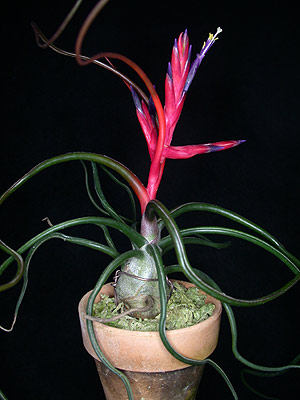
T. bulbosa pictured.
If you enjoyed this, please share it!


One response on “Bromeliad Air Plants”
Leave a Reply
Resource Download
Hechtia Care Cheat Sheet
Learn how to care for your Hechtia bromeliad with this quick and easy informational guide.
Learn More
Ask an Expert
Questions about bromeliads?
Our experts love a challenge!
Monique
Bromeliad Aechmea
Photo of the Week
Submit your photo to be featured on the blog!
More Photo of the Week Winners
Submit Photo
I have a potted plant with multi colored leaves but all the tips are turning brown! What do I do? thanks, pat