



How to Identify 4 Common Bromeliad Diseases
Author: Melanie Dearringer30 Comments
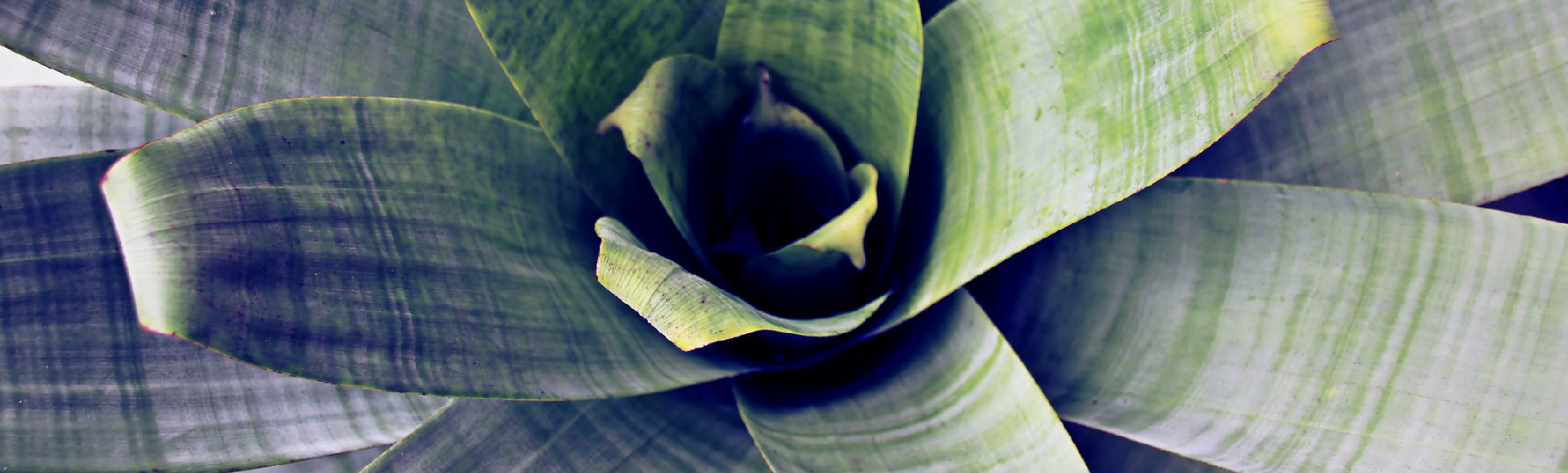
Many problems commonly attributed to diseases are the result of unfavorable growing conditions. Bad potting mix and overwatering can cause many bromeliads to rot. Plants subjected to mechanical injury, insects, or sunburn may be invaded by one of many fungi. A wide variety of diseases are reported on bromeliads, but with decent culture most growers find the plants to be relatively pathogen free.
1. Root rot and crown rot, sometimes referred to as heart rot, are commonly caused by the same organism. Phytyophthera cinnamomi is a fungus that can be found in many potting soils and is the organism responsible for many cases of bromeliad rot. It is naturally kept at bay by a parasitic fungus called, Trichoderma. The problem occurs when the air loving Trichoderma is killed off by lack of oxygen. Overwatering your bromeliad and allowing the potting mix to remain sopping wet can stifle the oxygen level in the soil which smothers the helpful Trichoderma.
Signs of crown rot
- Unpleasant odor emitting from the center of the plant
- Crown appears brown and soggy
- Leaves easily fall off with a gentle tug
2. Pythium is a genus of parasitic plant pathogens called Oomycetes. Pythium is also responsible for plant rot but primarily attacks the plant’s root system. While Phytyphthera tends to be more picky about their hosts, Pythium will unbiasedly infect a wide range of hosts.
Signs of root rot
- Dark, mushy roots
- Discoloring (often a bland grayish-green color
- Wilting
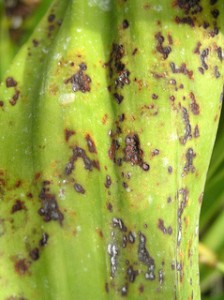
-Leaf spot
3. Helminthosporium leaf spot is another fungal disease caused by the organism Exserohilum rostratum. The spots first appear yellow and blister like. As the infection evolves, the spots will enlarge and become sunken and brown. A yellow border may still appear around the outer edge of the spot. In advanced stages, leaves can begin to collapse and hang from the bromeliad.
Signs of leaf spot
- Small, water-soaked spots that are yellow in color
- Brown, limp leaves
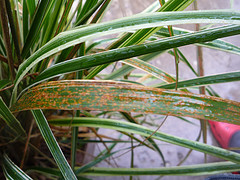
-Rust disease
4. Rust disease appears as rust colored, liquid filled blisters on the underside of the bromeliad’s leaves. The blisters will make their way through the leaves eventually showing as a white or for light yellow spot when viewed from the topside.
Signs of rust disease
- Rust colored bumps on the underside of the bromeliad’s leaves
- White or light yellow spots on the upper sides of the leaves
Source
Wikipedia http://en.wikipedia.org/wiki/Pythium
Root rot & Heart rot http://www.bromsqueensland.com.au/sites/bsq.sites.go1.com.au/files/Heart%20Rot%20%26%20Root%20Rot%20V2013%20v2.pdf
Common Diseases and disorders of Bromelia http://www.plantfinder.com/Services/ARChase/bromelia.asp
Rust disease photo credit: eXtension.org via https://www.flickr.com/photos/extensionhorticulture/2864419874/
Leaf spot photo credit: Scot Nelson via https://www.flickr.com/photos/scotnelson/12837704205/
Featured image photo credit: Nico Nelson via https://www.flickr.com/photos/niconelson/12141720534/
If you enjoyed this, please share it!


30 Responses to “How to Identify 4 Common Bromeliad Diseases”
Leave a Reply

Resource Download
Hechtia Care Cheat Sheet
Learn how to care for your Hechtia bromeliad with this quick and easy informational guide.
Learn More
Ask an Expert
Questions about bromeliads?
Our experts love a challenge!
Monique
Bromeliad Aechmea
Photo of the Week
Submit your photo to be featured on the blog!
More Photo of the Week Winners
Submit Photo
A friend of mine has a black spot infestation in her bromeliads, she has given me one that has black spot and I have quarantined it. Is there anything that I can treat it with, also what causes the problem. Thankyou
Wendy Jobberns
I have to same problem.
We purchased three large flowering, orange colored bromeliads and the color of the flowers were quite brilliant. First, we put them on our covered, east exposure porch where they only obtained about an hour of morning sun. Then with winds causing problems, I took them into our indoor sorarium that is cooled in New Mexico with swamp coolers giving off sufficient humidity for the plants in this large, high ceiling room. I placed the bromeliads in three different places with varying light, mostly sky light and then about 30 minutes of evening Western sun. No matter where they are moved, they all seem to be loosing the orange color in the flower turning to light greenish color. The long green leaves look OK. I have only kept water in the cups about once each week. Please tell me how to keep the color in the flowers? Thank you, Dr. Don Hardisty, Las Cruces NM email: [email protected]
It look that They are not getting to much sun.
@Dr. Don – Refer to this post Blooming Bromleiads Again and decide what the best option is for you and your plants. It is not uncommon for older plants to loose color and fade. All you need to do is bloom it again and again for long lasting color (it typically takes extra care to bloom a bromeliad from a pup).
@Wendy – Black spots or soft rotting spots are usually caused by fungus or disease (although Bromeliads rarely get diseases). Sometimes a yellowish color can also appear in the center of the spot.
To get rid of the rot just cut all rot or damaged area away with a sharp tool and treat the Bromeliad with a good quality fungicide (be sure to follow manufacturers instructions).
Wash all the tools you use and anything that comes in contact with the fungus to prevent spreading it to other plants.
Rotting or fungus is typicall attributed to sudden drops in temperature, high or low light conditions, mechanical injury or insect damage.
I have just purchased the most beautiful Bromeliad plant but I have a white film on the leaves. Please email a solution. Thanks
One of my students gave me a bromeliad for Christmas and I love it. The problem is that the colorful part died and is now brown. What should I do? I water it every week and I re-potted it in a larger planter and it sits in the kitchen window where it gets a little bit of indirect light. HELP!
Hi, does does your plant have a side shoot? Most bromeliads shoot out pups from the side of them after flowering. The mother plant then is done and spent. There are videos on you tube which show you how to remove the pup and replant for new flowers.
I have a beautiful violet Bromeliad that has flourished and brought my home much beauty but I noticed about a week ago that the soil in the pot is covered with a white film as is the base of the plant’s leaves. To make matters worse, one morning last week it sprouted a large amount of white mushroom looking things that we immediately removed from the pot. This has now occurred a second time. Despite this malady it has also sprouted a youngster! The plant looks very healthy but I have quarantined it for fear that my other plants may become infected with this fungus. Is the fungal treatment good for the growth of mushrooms also? I want to separate the two plants as the baby is growing very rapidly but I’m afraid I will kill the entire plant if I do this. Any suggestions are appreciated.
I purchased a bromeliad and it already had a lovely colored bloom. However, the bloom is dying and the leaves are still green and vibrant. Am I losing the entire plant or does the bloom die off and another grow back in it’s place? If the plant is still good without the bloom, how do I remove the dead bloom without hurting the core or the remainder of the plant? HELP
I have had a Bromeliad plant. Do the pups have to be removed and replanted? The mother plant flower has died, how should it be pruned, and will another flower regrow?
Please e mail me for help.
Hi. Yes, as mentioned in my comment earlier, the mother plant will flower then die. However, as she flowers she will send out pups. You can carefully remove the pups trying to keep some roots attached. I dip in rooting powder then replant the pups. The mother is then discarded as she has done her job. There are videos on you tube showing you how to do this.
I bought a big vase with 5 bromeliads in it last summer. Now, 8-9 months later, the colorful part (flowers) died and are totally dry and brown. Most of the leaves are still beautiful and green though. What should I do? Please help me with any ideas or solutions. Many thanks in advance.
I need some help. My bomeliads is rotting at the core! I have cut it down and replanted it in a bigger pot. It has a smell of fish. What else can i do to help it?
Thank you
Linda
Three years ago I brought home a bromeliad/superb sensation, marked by a beautiful color of pink spike like bloom. I enjoyed the long life of the flower and it also gave me back 8 pups. The last of the pups I left on the plant until the mother died so it was good size. It grew nicely indoors with plenty of filtered sunlight. Recently my mother in law told me that you can get them to flower by putting them outside. I made two mistakes in doing this. The first I put a small amount of gnat killer in the soil along with other house plants. The second, I put it in a fairly good shady area on my balcony which has all day sun. less than a few days later the big brown blotches showed up and now I’m thinking of bringing them back inside. so much for that method. If the plant lives I’ll try the plastic bag with fruit inside approach. I could kick myself. if you know of a way to salvage this plant please let me know.
I too had purchased a beautiful bright blooming of red and yellow bromeliad…however, lasting a very long time the bloom has turned brown and the leaves remain bright green..it does have a pup..do I cut the dead bloom off at the base of the plant? Will this harm the pup…the bloom is not pretty anymore:(
Hello
As a fresh http://www.bromeliads.info user i just want to say hello to everyone else who uses this site 😉
Approx. 3 years ago, I purchased a large bromeliad Mother plant. Her flower was badly faded, so I clipped it off. Approx. 5 green leaf babies, about 5″ tall, were coming from the base of her trunk. I cut all 5 away from her, to which only 1, to my remembrance, had already developed a root system. I kept & planted the rooted baby into an approx. 7″ tall pot. I’ve kept it inside during winter, placed outside on covered porch rest of year for great light & partial sun, keeping it watered in the top, into the dirt, & watering the leaves when they looked dry. This week, I looked into it to check on the water level, saw a mass of what looked like white cotton. Thinking it might be disease, I Q-Tipped it out. While doing this, I spotted a baby sprout, approximately 1 1/2″ tall, growing between 2 of the thick leaves. I checked again today, the new sprout has definitely gotten thicker during the last 24 hours. So, I’m hoping that my plant is producing a baby. Can’t wait to see if this is the case! I’m wondering now if I should have disturbed the white mass down in the center of the plant? What do you think?
I have a small Bromeliad that had a bright Red center color, it has now turned brown but still feels fleshy. Also I left the plant in the window to get indirect sunlight and my cat chewed the leaf ends before I could stop him. It seems to be doing Ok but I am still concerned, I did repot the plant and water it about every 3rd-4th day.
Any idea why our new (bought 4 days ago) bromeliad is oozing a clear sticky substance? It seems to be coming out near where the flower meets the leaves.
(Our bromeliad has the big flat fan-like pink flower).
I didn’t see this problem in troubleshooting I, II or diseases… any ideas?
I have a pink flower Bromeliad. The leaves have a white film on the fronts and mostly the backs. Some of the leaves also have rotten brown spots, probably, I figured out, from overwatering. How do I get rid of the white film? What solution do I spray on the leaves? Is soapy water sufficient?
Leaves have a white dust on bith sides
I have purchased a lovely Bromeliad and it has had a beautiful colored bloom.However, the bloom is dying and the leaves are still green. Am I losing the entire plant or does the bloom die off and another grow back in it’s place? If the plant is still good without the bloom, how do I remove the dead bloom without hurting the core or the rest of the plant? Can you please help me find out whats wrong with it. my email is :[email protected]
Thank’s, Kayla
Hi,
Our work plant is coming up with white spots. What can we do to combat this?
Can bromeliads survive in an 35 gallon aquarium with fluorescent light at two inches from it. I spray water over the plants every week
Will be happy to hear comments
My dog has been very naughty lately. He nibbled on the core leaves of my bromelaid. I’m afraid it won’t grow or it will just die….does anyone know what effects my plant will have???
Help! My pink bromeliad has crown rot. I cut out the mushy parts which were all in the middle, flushed it with water, dried it out and sprayed on some eco smart fungicide. I was told if the rot was in the middle the plant will die. What do I do?
Hi, I really need help, I think I’m slowly killing my bromelia.
On one of my leaves, theres starting some brown spots, but I’m not really worried about that. I was just going to remove the leaf, but on my big beautiful red flower, there seems to be like little shoots grown out of them,
I just thought the plant was growing nice new shoots,
but now I don’t think that is the case, cause some of the shoots have now turned brown and look like they are died,
I think I’ve over watered it.
Is there any help you can give me please?
I have a BROMELIAD in my garden. It RECEIVES aBout four hours sun per dAy. The leaves are dying off from the tip Right back to the centre of the plant. Can anyone tell me hOe to remedy this problem. Thanks KaY