



Bromeliad Basics: Propagation
Author: Melanie Dearringer28 Comments
In this article you’ll find helpful information on the general propagation requirements for a bromeliad plant.
Propagation
For a deeper understanding of bromeliad propagation, download our free Beginner’s Guide to Bromeliad Pups.
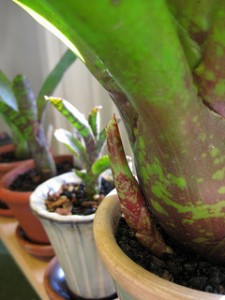
-Neoregelia “Cathy Doerr” pup
Bromeliads are grown from offesets, often called pups. Pups are exact clones of the mother plant on which they are grown. Some species develop offsets before they flower, but it is more typical to see pups emerging after the mother plant has bloomed and begun to decline. If desired, you can try to trim back the failing leaves of the parent plant to give the pups more light, but do not remove the offsets from the mother plant too soon as these offsets feed off of the deteriorating tissues of the parent plant.
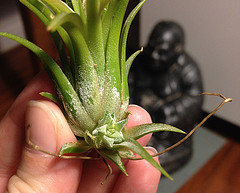
– Tillandsia ionantha guatemala pup
It is safe to remove and repot your bromeliad pups when they are one-third to one-half the size of the mother plant. It is usually best to do this by repotting the entire family. When removing a bromeliad offset, use a sharp, sterilized knife to separate the pups from the mother and then pot them in a slightly moist potting mix. Using medium that is too wet can cause these delicate plantlings to rot. Quick growing offsets may need to be repotted in as little as 6 months.
For even more information on bromeliad basic care, check out these great articles:
Bromeliad Basics: An Introduction
Bromeliad Basics: Temperature
Bromeliad Basics: Fertilizer
Bromeliad Basics: Watering
Bromeliad Basics: Lighting
Bromeliad Basics: Potting Medium
Bromeliad Basics: Repotting
Source
Neoregelia “Cathy Doerr” spotted pup photo credit: Gem via http://www.flickr.com/photos/its_gem/5495617750/
Tillandsia ionantha guatemala pup photo credit: Josie B. via http://www.flickr.com/photos/jozieb/10624078455/
If you enjoyed this, please share it!


28 Responses to “Bromeliad Basics: Propagation”
Leave a Reply
Resource Download
Hechtia Care Cheat Sheet
Learn how to care for your Hechtia bromeliad with this quick and easy informational guide.
Learn More
Ask an Expert
Questions about bromeliads?
Our experts love a challenge!
Monique
Bromeliad Aechmea
Photo of the Week
Submit your photo to be featured on the blog!
More Photo of the Week Winners
Submit Photo
So is it just not possible to leave the pup and the parent in the same pot, letting the pup take over as the parent declines?
You can if you want. Pups that are left on the mother plant will continue to grow and gradually overtake her. The dead leaves of the mother can eventually be removed.
I would also love to see the answer to Sarah’s post as I have a parent plant who has sprouted 4 pups and now the parent leaves are all spotted with yellow and the original green is fading…..can the pups be re-potted with one another, or is it best to re-pot them separately?
I have a pink bromeliad that has developed a pup and I want to bloom them/it again. When I put the plant in a clear plastic bag for 10 days with an apple do I cut up the apple or leave it whole??
Thanks Nettie Bradley Wilburn
10 30/07
Placing a whole, ripe apple in an air-tight bag with the bromeliad should do the trick. Here’s our blog post on force blooming: https://www.bromeliads.info/forcing-bromeliads-to-bloom/
Hello!
My name is Andrea P. I bought a bromeliad about two weeks ago. I don’t know what to do. My plant’s blossum is getting brown, and there are four “pups”(i believe they’re called) and i do not know how to care for it. You mention that i shouldn’t have them sitting in water, do you mean that there shouldn’t be any water in the dish? Pleaseenlighten me. I do not wish to have my beautiful new flower die, please i would much enjoy to have some instructions to care for my new flower.
thax!,
ansrea
p.s.
please e-mail me the information.
(in order to send any more information)(and possibally the the watering/planting/replanting/taking care of baby plants)thank you!!!
I too would like to know the answer to Sarah and Jackie’s questions. Is it possible to cut away the parent flower and leave the pups growing? Although everthing looks healthy the mother flower is dried and brownish and obviously is dying.
We’d recommend either cutting off the pups and repotting them when they are big enough, or if you prefer you can leave them attached to the mother plant until she dies. Eventually you may want to remove the dead mother plant from the pot.
how do i seperate the pups from the main plant
We’ve got a post about this very topic. You can find it here: https://www.bromeliads.info/beginners-guide-bromeliad-pups/
are the pups the colorful flower that comes off the side of the plant or the little green shoots at the bottom of the plant. Also what in the world are the little hairy things coming out of the ends of the plant. Please help I feel like I am responsible and don’t know what I am doing
I’ve had two bromeliads plants and I’ve managed to kill them both. I’m sure I’ve over watered them from what I’ve read on this website. It’s like the root of the stalk is rotting. It’s still in bloom, but the leaves are all starting to die. Is there any way I can still save it?
Signs that your bromeliad is suffering from root rot may be hard to see until it is too late. If the inner leaves are intact and do not come apart when tugged, you may be able to save your plant.
Remove the plant from the substrate. Dip it in a fungicide or a root hormone that also contains fungicide. Then, stake it up in a well draining potting medium or next to a healthy bromeliad. The bromeliad should recover and develop roots.
I have read somewhere very resent to take the pups off of the mother plant when half the size of the mother ( I have 13 altogether) put in seperate pots,place a slic eof apple next to the plat and place in a bag. My question is how lond do I leave the pups there?
While watering my bromeliad, the flower broke off! Can I repot this flower, and if so, do I keep the flower in water to grow roots or just plant it in a pot? Please advise and thank you.
hi
I would also like to know if the pups can stay attached to the parent plant, I have cut the parent plant down to the base nearly, to allow the light through. kind regards carolyn
Should I wait until the mother plant is finish flowering, and will I be able to see the root’s without removing the pup from the mother plant?
Where can I read your answers to all the questions people have posted in Comments? Specifically the answers regarding “Caring for Bromeliads – Part Seven -Propagating”. Are you answers only e-mailed privately to each commentor? Or is there a link I can click on? Thanks, Mary
Dear bromeliad expert:
Our bromeliad had a bright red bloom when we bought it, and it looked good for the first month that we kept it indoors. Two months ago, some of the green leaves began to turn brown, gradually getting worse until the entire plant including the bloom had become withered and brown.
Despite the mother plant dying, 3 pups emerged about a month ago. Although they haven’t grown much since then, now they are 2-3 cm tall.
In the past week, our bromeliad has looked worse and worse, with brown spreading to almost the entire surface of every leaf and the whole plant leaning to one side. The stem was kinked in two places and smelled like it was rotting, so I decided to remove it. Because the stem was soft and wet, I was able to simply rip off the stem near the base without pulling up the underground portion.
Afterwards, I realized that the pups weren’t tall enough (1/3 the size of the mother) as suggested . What can I do to ensure they survive without the mother plant? Should I have left the dying, rotting mother in place or did I do the right thing?
Is it bad to leave bromeliads indoors with the air conditioning running? I read that they like humidity. Is there any way to keep them inside with the AC on?
Thanks in advance for your help!
Jason & Karen
I have a healthy mother plant with three pups about 3/4 the size. I know it is time for the pups to be cut but I have no idea on how to do this. I would also like to keep the mother plant if possible. Any advice would be helpful. Thank you.
Hi Tiffany,
Check out our post on bromeliad pups and see if that helps answer your questions 🙂
https://www.bromeliads.info/beginners-guide-bromeliad-pups/
I have six plants in the ground outside. I live in South Florida. Should I just leave the parent plants as is until the pups arrive? It looks rather shaby right now as the parent plants have faded and nothing has happened.
How long after the pups arrive do I have to wait before I removed the old parent plant?
Thanks you.
great questions, many of which are relevant to me as well. Where are the answers?
We’ve just recently updated several of the questions on here with answers. Are there any specific questions you have that we could address for you?
where are the answers? I would like to see them right after the question. thanks
Hi Arlene,
We apologize, it seems this post was overlooked for some time. We’ve gone ahead and answered several of the more frequent questions on here, but if there’s something specific we can help you with just let us know!
Hi, i bought my plant today and i am very excited at trying my hand at caring for this lovely specimen but though my plant is easily 10″” tall, the pot it came in is 3″”. should i repot it?
Can bromeliads thrive near a pond?